Curriculum
Smart4Food MicroLearning Course
INTRODUCTION
0/1
Module 1: Digital Tools for Smart Farming
0/22
Module 2: Sustainable and Regenerative Agriculture: Soil, Water and Biodiversity Management for Small-Scale Farms
0/16
-
MODULE 2 - INFORMATION
 Trial
-
MODULE 2 - INTRODUCTION
Trial
-
UNIT 1 - WHY REGENERATIVE FARMING MATTERS
Trial
-
UNIT 1 - REFLECTION ACTIVITY
Trial
-
UNIT 1 - QUIZ
 Trial
-
UNIT 2 - SOIL HEALTH BASICS
Trial
-
UNIT 2 - QUIZ
Trial
-
UNIT 3 - WATER MANAGEMENT
Trial
-
UNIT 3 - REFLECTION ACTIVITY
Trial
-
UNIT 3 - QUIZ
Trial
-
UNIT 4 - BIODIVERSITY ENHANCEMENT
Trial
-
UNIT 4 - REFLECTION ACTIVITY
Trial
-
UNIT 4 - QUIZ
Trial
-
UNIT 5 - CIRCULAR FARMING
Trial
-
UNIT 5 - REFLECTION ACTIVITY
Trial
-
UNIT 5 - QUIZ
Trial
Module 3 - Smart Marketing and Communication for Small Producers
0/27
Module 4 - Local Food Systems and Short Supply Chains
0/14
Module 5 - Training and Education for Rural Development
0/14
Module 6 - Policy Innovation and Project development in the Agrisector
0/15
UNIT 5 – CIRCULAR FARMING
1. What circular farming means
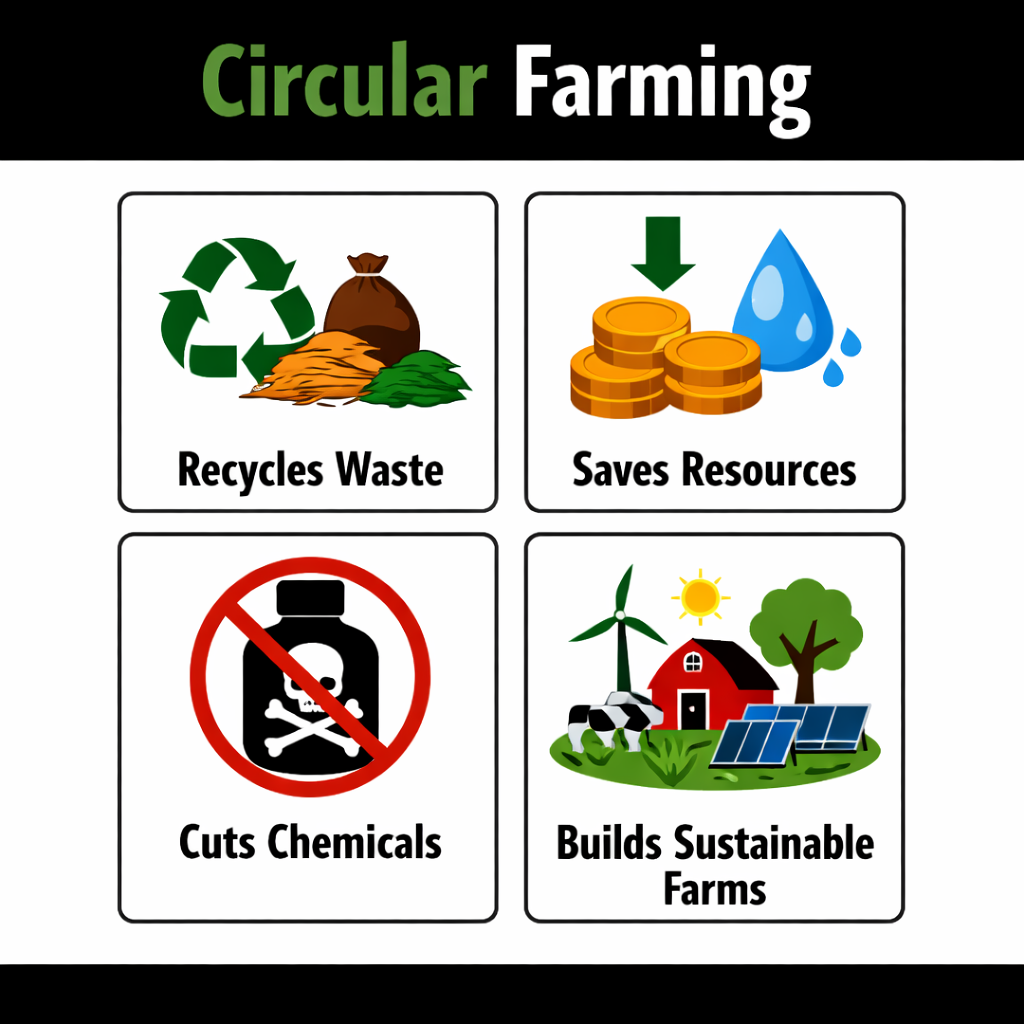
Circular farming is a system where waste is reused instead of thrown away. Materials like crop residues, manure, and water are recycled and used again on the farm.
Learners can explain that circular farming:
Reduces waste and pollution
Saves money and resources
Decreases chemical fertiliser use
Supports sustainable, independent farms
2. Reuse of crop residues and manure
After harvest, farmers have straw, leaves, stems, and animal manure.
Instead of burning or discarding them, they can turn waste into value.
Learners can describe two reuse methods:
Composting — waste breaks down into compost that improves soil fertility
Biogas production — waste in a biodigester creates biogas for energy and fertiliser
3. On-farm energy loops
On-farm energy loops mean producing and using energy directly on the farm.
Learners can identify examples:
Solar drying — uses sunlight to dry crops and save electricity
Bio-digesters — turn waste into biogas and fertiliser, creating a closed loop
These systems reduce waste and increase farm independence.
4. Local feed and seed exchanges
Local exchanges mean sharing or buying seeds and feed nearby instead of from distant suppliers.
Learners can analyse that local exchanges:
Reduce transport and carbon emissions
Support local farmers
Protect traditional seed varieties
Strengthen community and biodiversity