Curriculum
Smart4Food MicroLearning Course
INTRODUCTION
0/1
Module 1: Digital Tools for Smart Farming
0/22
Module 2: Sustainable and Regenerative Agriculture: Soil, Water and Biodiversity Management for Small-Scale Farms
0/16
Module 3 - Smart Marketing and Communication for Small Producers
0/27
Module 4 - Local Food Systems and Short Supply Chains
0/14
Module 5 - Training and Education for Rural Development
0/14
-
MODULE 5 — INFORMATION
 Trial
-
MODULE 5 — CORE CONCEPT
Trial
-
UNIT 1 — UNDERSTANDING RURAL LEARNER PROFILES AND CHALLENGES
Trial
-
UNIT 1 — REFLECTION ACTIVITY
Trial
-
UNIT 1 — QUIZ
 Trial
-
UNIT 2 — MICROLEARNING DESIGN PRINCIPLES FOR RURAL EDUCATION
Trial
-
UNIT 2 — REFLECTION ACTIVITY
Trial
-
UNIT 2 — QUIZ
Trial
-
UNIT 3 — ENGAGEMENT TECHNIQUES: VISUAL, TACTILE, NARRATIVE
Trial
-
UNIT 3 — REFLECTION ACTIVITY
Trial
-
UNIT 3 — QUIZ
Trial
-
UNIT 4 — FEEDBACK TOOLS AND REFLECTIVE PRACTICES
Trial
-
UNIT 4 — REFLECTION ACTIVITY
Trial
-
UNIT 4 — QUIZ
Trial
Module 6 - Policy Innovation and Project development in the Agrisector
0/15
UNIT 1 — UNDERSTANDING RURAL LEARNER PROFILES AND CHALLENGES
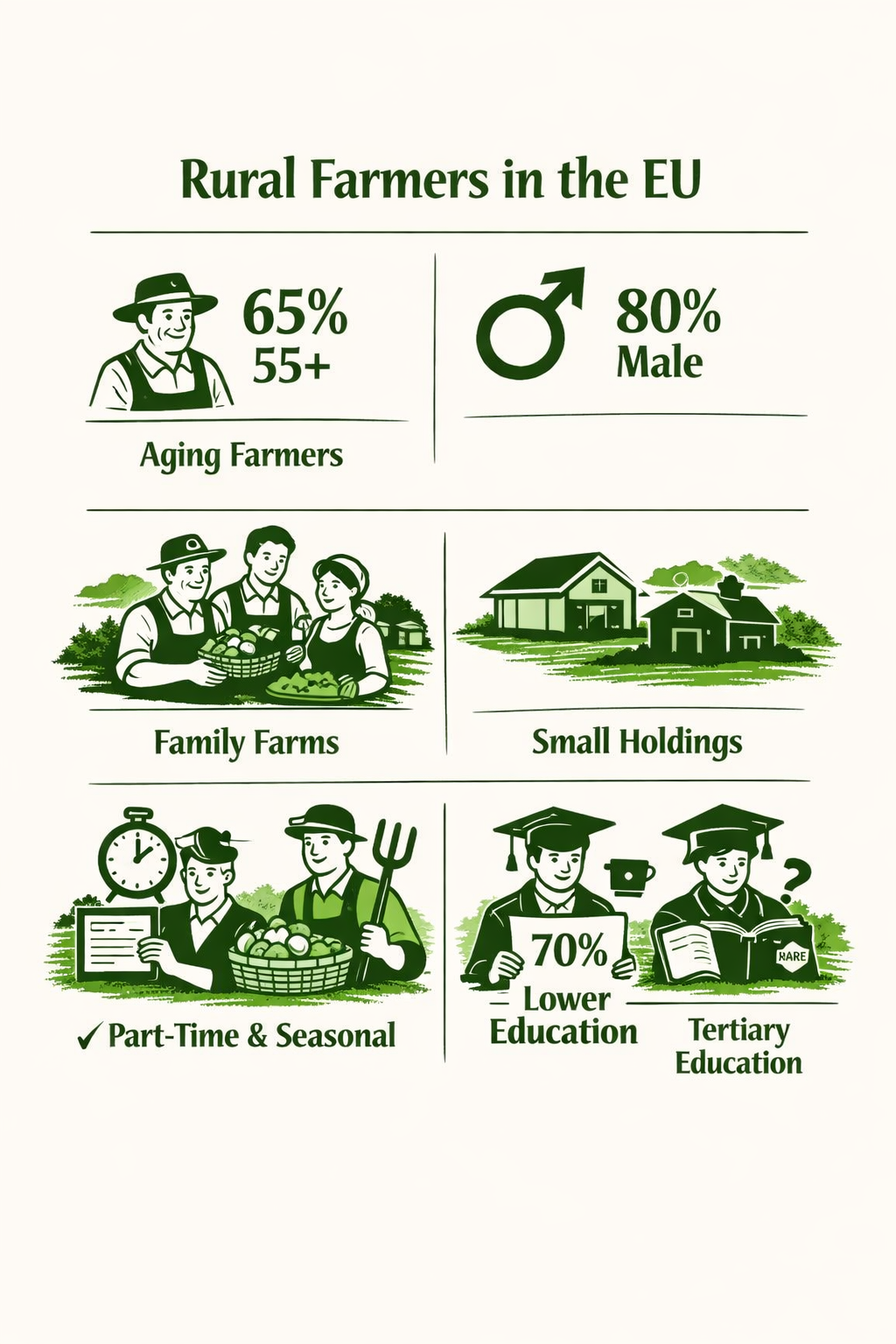
Who are rural farmers in the EU?
Rural farmers in the EU are predominantly older, male, family-based farm holders working mainly on small holdings. Farming often involves part-time and seasonal labour, and attracting younger generations remains a challenge. A large share of farmers have only lower secondary education or less. Tertiary education is relatively rare among farmers compared to other professions.
Agricultural training of farm managers
The majority of farm managers rely on practical experience rather than formal training. Around 70% of farm managers have gained skills mainly through on-the-job or family-based learning. Only a small proportion have completed full formal agricultural training. A further group has basic agricultural training, often short or vocational.
Age and education
Younger farmers are more likely to have formal agricultural education. Older farmers tend to rely almost exclusively on experience-based knowledge.
Language diversity, regional dialects, and varying literacy levels are common and should be considered when designing online content. Many rural areas are linguistically diverse, with regional dialects, multilingual environments, and varying literacy levels. Recognising these backgrounds helps educators design learning that is accessible, relevant, and respectful.
Motivation and goals
Farmers are mainly motivated by practical outcomes, such as:
· Improving agricultural productivity and animal welfare.
· Applying sustainable resource management.
· Developing digital skills for modern markets and smart farming.
· Strengthening their family businesses and local communities.
Challenges
Rural learners may face several barriers:
· Limited internet access or digital infrastructure.
· Seasonal workload peaks.
· Low confidence in formal education.
· Reduced motivation when content feels irrelevant.
Key implications for learning and training
Effective learning methods for rural learners include:
· Practical, real-life examples from farming contexts.
· Visual materials and step-by-step demonstrations.
· Storytelling and experience-based learning.
· Flexible formats, especially mobile and asynchronous learning.
By doing so, educators can improve learning outcomes and ensure rural learners feel supported, capable, and valued.
Gamification activity: https://wordwall.net/resource/110015417/match-the-farmer-profile