Curriculum
Smart4Food MicroLearning Course
INTRODUCTION
0/1
Module 1: Digital Tools for Smart Farming
0/22
Module 2: Sustainable and Regenerative Agriculture: Soil, Water and Biodiversity Management for Small-Scale Farms
0/16
Module 3 - Smart Marketing and Communication for Small Producers
0/27
Module 4 - Local Food Systems and Short Supply Chains
0/14
-
MODULE 4 — INFORMATION
 Trial
-
MODULE 4 — CORE CONCEPT
Trial
-
UNIT 1 — What are Local Food Systems
Trial
-
UNIT 1 — REFLECTION ACTIVITY
Trial
-
UNIT 1 — QUIZ
 Trial
-
UNIT 2 — Typologies of Short Food Supply Chains (SFSCs)
Trial
-
UNIT 2 — REFLECTION ACTIVITY
Trial
-
UNIT 2 — QUIZ
Trial
-
UNIT 3 — Building Local Partnerships and Cooperatives
Trial
-
UNIT 3 — REFLECTION ACTIVITY
Trial
-
UNIT 3 — QUIZ
Trial
-
UNIT 4 — Planning a Localized Food Distribution Strategy
Trial
-
UNIT 4 — REFLECTION ACTIVITY
Trial
-
UNIT 4 — QUIZ
Trial
Module 5 - Training and Education for Rural Development
0/14
Module 6 - Policy Innovation and Project development in the Agrisector
0/15
UNIT 3 — Building Local Partnerships and Cooperatives
In Short Food Supply Chains, collaboration is not optional. It is embedded in how local actors operate. Small producers, consumers, and local institutions depend on horizontal partnerships built on trust and shared value.
Working together enables producers to pool resources, share logistics, access infrastructure such as storage, processing, and distribution, and increase visibility through collective branding. Collaboration also includes multi-actor partnerships with municipalities, NGOs, and consumers. These networks proved vital during crises such as COVID-19, when communities reorganised food flows quickly.
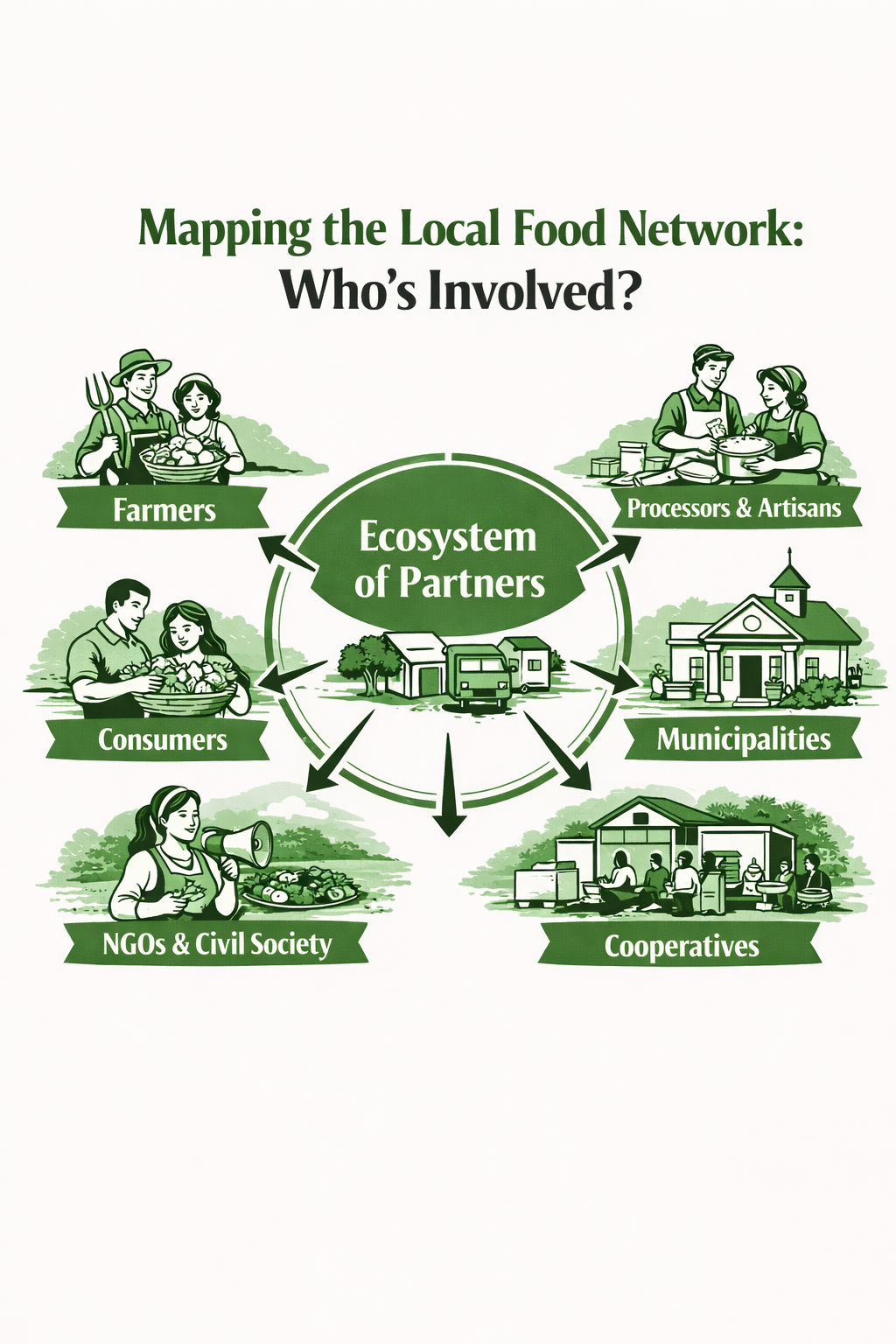
Local food networks are ecosystems of interconnected actors. Each actor contributes to the vitality and sustainability of SFSCs:
· Farmers provide raw materials and often manage direct sales.
· Processors and artisans add value and preserve local identity.
· Consumers act as co-producers through CSAs or purchasing groups.
· Municipalities enable markets, procurement, and infrastructure.
· NGOs and civil society advocate, educate, and mobilise communities.
· Cooperatives formalise collective action and ensure fair participation.
Recognising these roles helps build inclusive, place-based food systems. Stakeholder mapping reveals how these actors connect and where collaboration can grow. It should also pay attention to underrepresented actors, such as women farmers and informal vendors.
Cooperatives help small producers overcome isolation and scale limitations. They provide shared solutions for logistics, market access, and branding.
Key benefits of cooperatives include shared logistics, improved market access, joint branding, learning and innovation, and democratic governance. Through cooperation, decisions and profits can be shared more equitably. Cooperation transforms food from a commodity into a community asset, reinforcing fairness and sustainability.
Collaboration can evolve into collective governance when actors co-design food strategies. Supported by EU frameworks such as LEADER and CLLD, these partnerships link food, community, and sustainability.
Important outcomes of collective governance include stronger social capital, shared decision-making, innovation rooted in territorial identity, and crisis resilience. Food becomes a vector for community building, not only trade. Governance means shaping food systems that are short, smart, and fair.
Stakeholder mapping is a strategic tool used to understand who influences or is influenced by local food systems. It helps producers, cooperatives, municipalities, NGOs, and communities coordinate actions and design stronger short food supply chains.
Key steps in stakeholder mapping include:
· Identification — recognising all relevant actors in the food system.
· Categorisation — analysing stakeholders according to power, interest, influence, and engagement.
· Visualisation — using tools such as power-interest matrices and mapping tables.
· Participation — involving local actors through workshops, interviews, and collaborative exercises.
Common stakeholder mapping tools include power-interest matrices, stakeholder mapping tables, participatory mapping, and geospatial mapping. Stakeholder mapping is not only technical. It is relational and ethical. It supports systems thinking and helps communities move from fragmented actions to coordinated food strategies.