Curriculum
Smart4Food MicroLearning Course
INTRODUCTION
0/1
Module 1: Digital Tools for Smart Farming
0/22
Module 2: Sustainable and Regenerative Agriculture: Soil, Water and Biodiversity Management for Small-Scale Farms
0/16
Module 3 - Smart Marketing and Communication for Small Producers
0/27
Module 4 - Local Food Systems and Short Supply Chains
0/14
-
MODULE 4 — INFORMATION
 Trial
-
MODULE 4 — CORE CONCEPT
Trial
-
UNIT 1 — What are Local Food Systems
Trial
-
UNIT 1 — REFLECTION ACTIVITY
Trial
-
UNIT 1 — QUIZ
 Trial
-
UNIT 2 — Typologies of Short Food Supply Chains (SFSCs)
Trial
-
UNIT 2 — REFLECTION ACTIVITY
Trial
-
UNIT 2 — QUIZ
Trial
-
UNIT 3 — Building Local Partnerships and Cooperatives
Trial
-
UNIT 3 — REFLECTION ACTIVITY
Trial
-
UNIT 3 — QUIZ
Trial
-
UNIT 4 — Planning a Localized Food Distribution Strategy
Trial
-
UNIT 4 — REFLECTION ACTIVITY
Trial
-
UNIT 4 — QUIZ
Trial
Module 5 - Training and Education for Rural Development
0/14
Module 6 - Policy Innovation and Project development in the Agrisector
0/15
UNIT 2 — Typologies of Short Food Supply Chains (SFSCs)
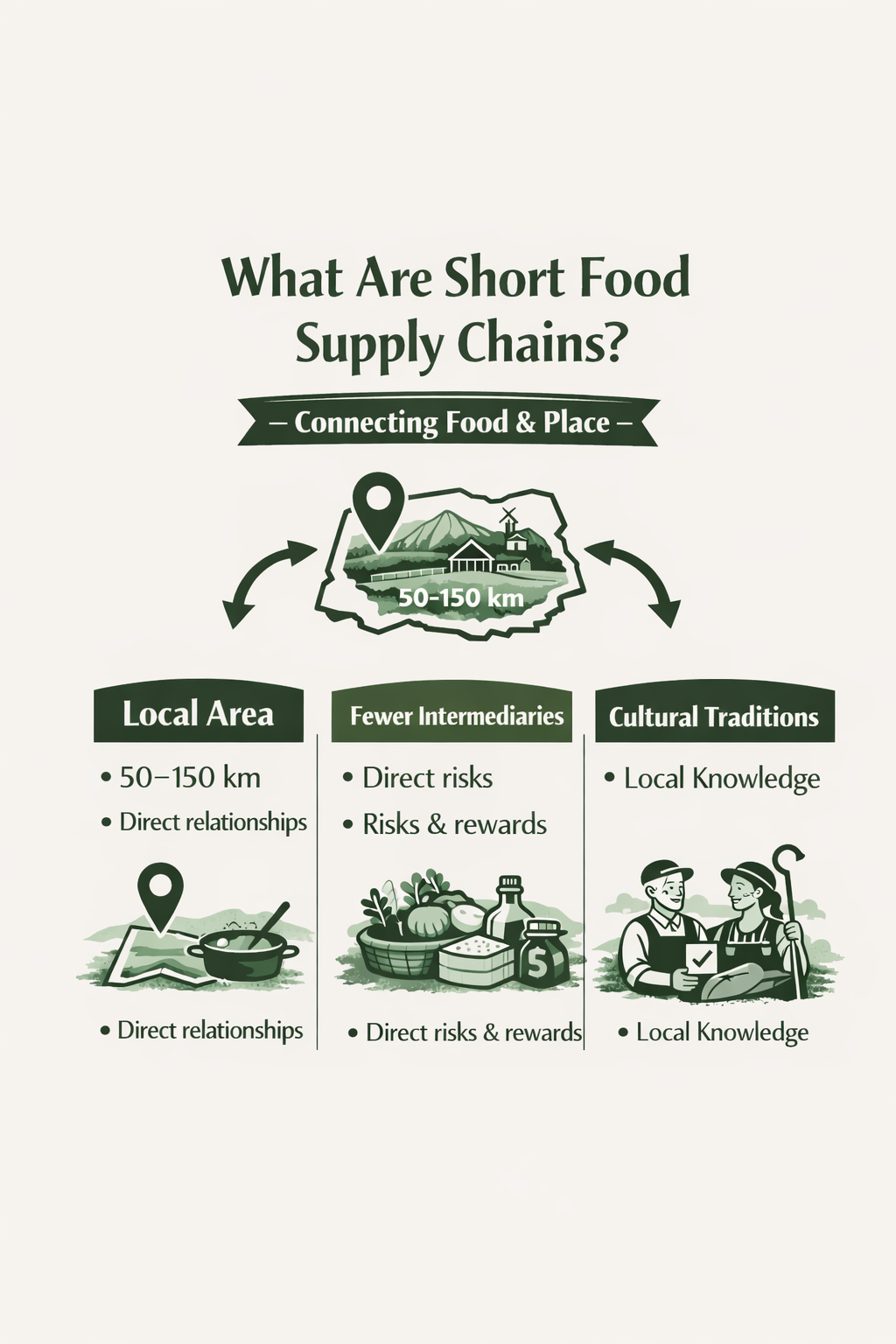
A Short Food Supply Chain (SFSC) reduces or removes intermediaries between producers and consumers. The European Commission defines SFSCs as supply chains involving a limited number of economic operators, committed to cooperation, local economic development, and close geographical and social relations.
SFSCs emphasise trust, transparency, and local value through four key principles:
1. Spatial proximity — production and consumption within 50–150 km.
2. Organisational proximity — fewer intermediaries and fairer value distribution.
3. Relational proximity — direct interaction and trust.
4. Value-based governance — sustainability, equity, and cultural continuity.
SFSCs support rural resilience, preserve traditions, and align with EU strategies such as Farm to Fork and LEADER/CLLD.
Direct sales occur when producers sell directly to consumers through on-farm shops, roadside stands, or seasonal stalls. They involve zero intermediaries, full value retention, and personal connection.
Farmers’ markets gather multiple producers in public spaces. They create community visibility and local food culture, promote seasonal consumption, and strengthen civic ties between agriculture and everyday life.
Both direct sales and farmers’ markets rely on face-to-face trust and territorial identity, making them useful models for small producers and rural revitalisation.
Short Food Supply Chains can also evolve through collaborative models, from community-based partnerships to collective logistics networks.
Community Supported Agriculture (CSA) creates a direct, solidarity-based partnership between producers and consumers. Consumers pre-purchase a share of the farm’s harvest. Risks and rewards are shared across the season. Farmers gain predictable income and reduced marketing pressure. Consumers gain fresh, local food and insight into production cycles. CSA builds trust, transparency, and co-responsibility.
Food hubs and cooperatives help small producers reach broader markets. They aggregate, process, and distribute products through shared infrastructure. They support fair pricing, traceability, and market access, including schools, canteens, and urban buyers. They also strengthen territorial branding and rural visibility.
Together, CSA, food hubs, and cooperatives increase producer autonomy, expand market reach, and support sustainable, values-driven governance.
SFSCs create value through transparency, traceability, trust, and producer empowerment. Consumers learn where food comes from and how it is produced, while producers regain control over pricing and storytelling.
Digital tools can strengthen SFSCs. These include e-commerce platforms for direct sales and logistics, social media for storytelling and community building, QR codes and blockchain for traceability and certification, and apps for delivery coordination and inventory management. EU initiatives such as Smart Villages and LEADER support digital literacy and innovation to make SFSCs scalable and inclusive.
Learning activity: Which Chain Fits Where?
Match each SFSC type with the correct definition and benefit:
· On-Farm Direct Sales — Consumers purchase products directly at the place of production, such as a farm shop or seasonal stand. Benefit: strengthens producer-consumer relationships and involves zero intermediaries.
· Farmers’ Markets — A physical marketplace where multiple local producers sell directly to consumers, usually once or twice per week. Benefit: builds local food culture and encourages seasonal and regional consumption.
· Community-Supported Agriculture (CSA) — A model where consumers commit in advance to purchase a share of a farm’s harvest over a growing season. Benefit: supports risk-sharing between farmer and consumer and provides upfront income for producers.
· Food Hubs / Cooperatives — Organised platforms or facilities that collect, process, and distribute food from multiple producers to local buyers. Benefit: enables logistics for small producers and supports school canteens and public procurement.
Optional learning resource from the source material: Drumshanbo Food Hub video — https://www.youtube.com/watch?v=pT2Y2mF9IUo