Curriculum
Smart4Food MicroLearning Course
INTRODUCTION
0/1
Module 1: Digital Tools for Smart Farming
0/22
Module 2: Sustainable and Regenerative Agriculture: Soil, Water and Biodiversity Management for Small-Scale Farms
0/16
Module 3 - Smart Marketing and Communication for Small Producers
0/27
Module 4 - Local Food Systems and Short Supply Chains
0/14
-
MODULE 4 — INFORMATION
 Trial
-
MODULE 4 — CORE CONCEPT
Trial
-
UNIT 1 — What are Local Food Systems
Trial
-
UNIT 1 — REFLECTION ACTIVITY
Trial
-
UNIT 1 — QUIZ
 Trial
-
UNIT 2 — Typologies of Short Food Supply Chains (SFSCs)
Trial
-
UNIT 2 — REFLECTION ACTIVITY
Trial
-
UNIT 2 — QUIZ
Trial
-
UNIT 3 — Building Local Partnerships and Cooperatives
Trial
-
UNIT 3 — REFLECTION ACTIVITY
Trial
-
UNIT 3 — QUIZ
Trial
-
UNIT 4 — Planning a Localized Food Distribution Strategy
Trial
-
UNIT 4 — REFLECTION ACTIVITY
Trial
-
UNIT 4 — QUIZ
Trial
Module 5 - Training and Education for Rural Development
0/14
Module 6 - Policy Innovation and Project development in the Agrisector
0/15
UNIT 4 — Planning a Localized Food Distribution Strategy
A localized food distribution plan connects local supply with local demand while reducing intermediaries. It balances logistics, economics, and relationships.
Five key steps support the development of a local food distribution plan:
1. Identify products — choose items with local, cultural, or seasonal value.
2. Map demand — locate buyers such as shops, schools, restaurants, and cooperatives.
3. Define channels — select direct sales, shared delivery, or food hub models.
4. Build visibility — use storytelling, branding, and fair pricing.
5. Write and review the plan — document logistics, partners, and timelines, and update regularly.
Planning is participatory and adaptive. It helps producers regain control and strengthen local economies.
A strong local distribution strategy integrates four interconnected components:
1. Distribution points — physical or digital spaces such as markets, canteens, restaurants, and online platforms. Diversifying distribution points helps reach different consumers and reduce risk.
2. Pricing strategies — fair, transparent, and context-sensitive pricing that reflects production costs and local value while staying accessible.
3. Logistics — storage, transport, and delivery coordination. Shared vehicles, route planners, and cold-chain management can cut costs and emissions.
4. Marketing and communication — telling the story behind the food through local branding, social media, and community events to build trust and loyalty.
Together, these components ensure that local food is visible, viable, and valued.
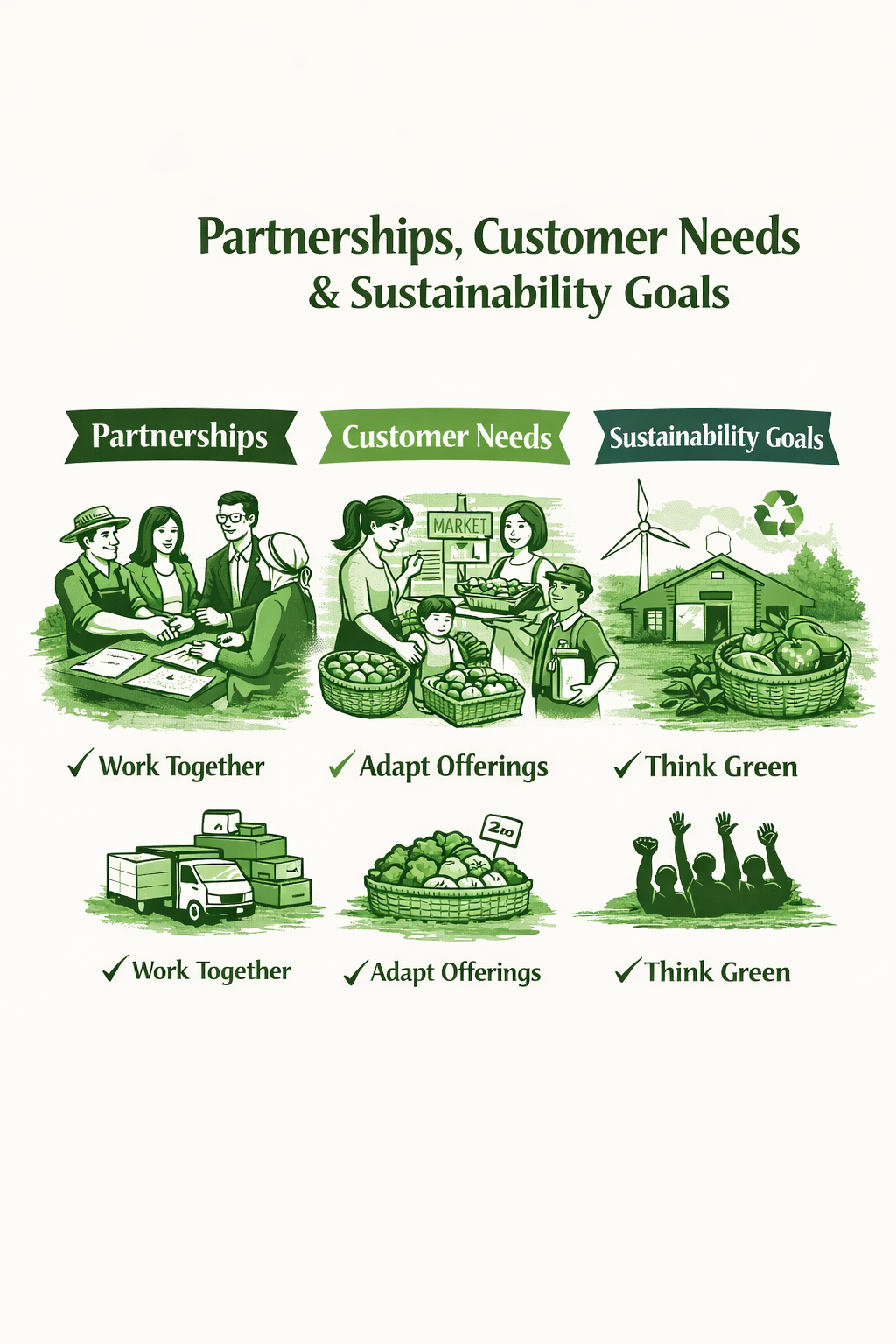
A successful local food strategy also rests on three pillars: partnerships, customer needs, and sustainability goals.
Partnerships connect producers, municipalities, NGOs, schools, and tech providers. Each partner adds resources, infrastructure, or social capital. Cooperation can be formalised through agreements or co-design workshops.
Customer needs require understanding who buys and why. Families, institutions, and tourists may have different priorities, such as freshness, price, or authenticity. Surveys and feedback loops can help adapt products and delivery formats.
Sustainability goals embed environmental and social values. These may include reducing food miles, supporting fair employment, and aligning with EU Green Deal or Farm-to-Fork objectives. Impact can be tracked through simple indicators such as carbon footprint and local sourcing rate.
Small producers can use structured tools to design and monitor their distribution plans:
· Readiness checklist — assesses infrastructure, partners, and regulations.
· Local food distribution canvas — defines partners, customers, value proposition, logistics, and costs.
· Planning grids and scheduling templates — coordinate deliveries, storage, and seasonal cycles.
· Monitoring and evaluation tools — track deliveries, satisfaction, and carbon footprint.
· Sustainability alignment checklist — verifies that packaging, pricing, and sourcing meet sustainability goals.
These tools act as visual scaffolds: simple, adaptable frameworks that support learning and collaboration.
Example of a Local Food Distribution Canvas:
1. Key Partners
Guiding question: Who helps you deliver food locally? Examples: farmers, cooperatives, municipalities, NGOs, transporters, digital platforms.
Example entry: Local farmers’ cooperative, municipal market office, school canteen network.
2. Target Customers
Guiding question: Who are your main buyers or consumers? Examples: families, restaurants, schools, tourists.
Example entry: Families seeking fresh produce; local restaurants promoting regional cuisine.
3. Value Proposition
Guiding question: What makes your local food offer unique?
Example entry: Fresh, seasonal, locally sourced products with transparent origin and fair pricing.
4. Distribution Channels
Guiding question: How do you deliver products? Examples: direct sales, food hubs, online orders, community delivery.
Example entry: Weekly farmers’ market, shared delivery van, online pre-order system.
5. Pricing Strategy
Guiding question: How do you set and communicate prices?
Example entry: Transparent pricing based on production cost plus fair margin; subscription model for weekly boxes.
6. Logistics & Operations
Guiding question: How do you manage transport, storage, and scheduling?
Example entry: Shared cold storage facility; delivery routes planned via route-planner app.
7. Marketing & Communication
Guiding question: How do you promote your products and values?
Example entry: Local branding, social media storytelling, tasting events.
8. Sustainability Goals
Guiding question: How do you ensure environmental and social responsibility?
Example entry: Reduce packaging waste; use electric delivery vehicle; support local employment.
9. Key Resources
Guiding question: What assets or infrastructure do you rely on?
Example entry: Farm produce, cooperative warehouse, delivery van, digital ordering platform.
10. Cost Structure
Guiding question: What are your main expenses?
Example entry: Transport fuel, packaging, market fees, staff time.
11. Revenue Streams
Guiding question: How do you generate income?
Example entry: Direct sales, CSA subscriptions, institutional contracts.