Curriculum
Smart4Food MicroLearning Course
INTRODUCTION
0/1
Module 1: Digital Tools for Smart Farming
0/22
Module 2: Sustainable and Regenerative Agriculture: Soil, Water and Biodiversity Management for Small-Scale Farms
0/16
Module 3 - Smart Marketing and Communication for Small Producers
0/27
Module 4 - Local Food Systems and Short Supply Chains
0/14
Module 5 - Training and Education for Rural Development
0/14
Module 6 - Policy Innovation and Project development in the Agrisector
0/15
-
MODULE 6 — INFORMATION
 Trial
-
MODULE 6 — CORE CONCEPT
Trial
-
MODULE 6 - CASE STUDY VIDEO
Trial
-
UNIT 1 — UNDERSTANDING AGRI-POLICY
Trial
-
UNIT 1 — REFLECTION ACTIVITY
Trial
-
UNIT 1 — QUIZ
 Trial
-
UNIT 2 — DESIGNING SMALL AGRI-PROJECTS
-
UNIT 2 — REFLECTION ACTIVITY
-
UNIT 2 — QUIZ
-
UNIT 3 — TRANSLATING LOCAL EVIDENCE INTO POLICY INFLUENCE
-
UNIT 3 — REFLECTION ACTIVITY
-
UNIT 3 — QUIZ
-
UNIT 4 — BUILDING RURAL INNOVATION NETWORKS
-
UNIT 4 — REFLECTION ACTIVITY
-
UNIT 4 — QUIZ
UNIT 1 — UNDERSTANDING AGRI-POLICY
Why EU agri-policy matters today
EU and national agri-policies are currently directed by the Common Agricultural Policy (CAP) 2023–2027. The EU is reshaping its food and farming systems to be climate-friendly, resource-efficient and competitive. The European Green Deal sets the direction for this transition.
· European Green Deal (2019): the EU’s long-term plan for climate neutrality and sustainable growth.
· Farm to Fork Strategy: a blueprint for fair, healthy and sustainable food systems.
· Common Agricultural Policy (CAP 2023–2027): the main framework guiding farm income support and rural development.
What is changing after 2027?
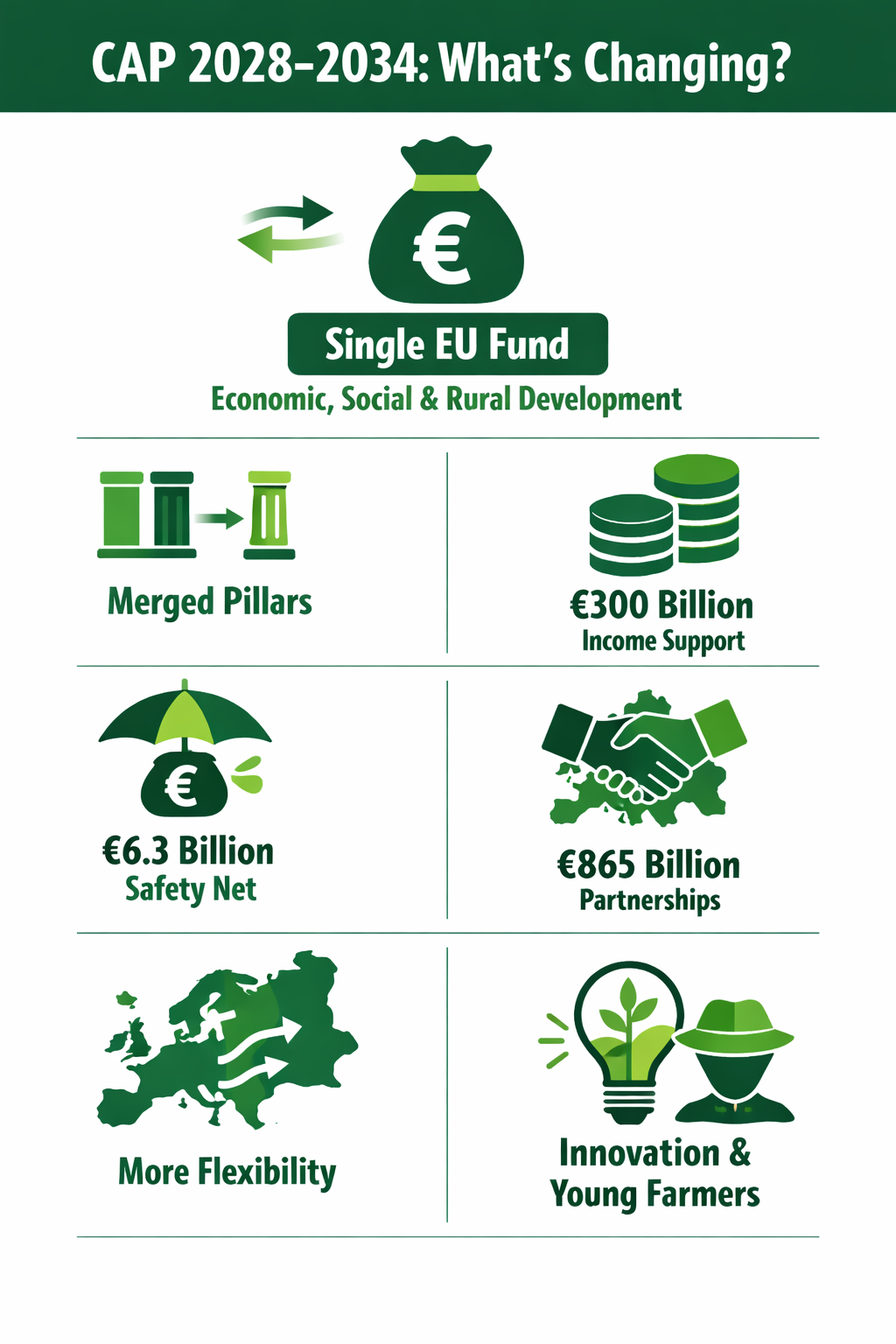
The current CAP operates under two pillars. The source material presents a simplified overview of a future direction in which agricultural funding would be integrated into a broader fund structure.
· CAP becomes part of a single broader fund: European Fund for Economic, Social and Territorial Cohesion, Agriculture and Rural Prosperity.
· The current two pillars, EAGF and EAFRD, merge into one fund.
· EUR 300 billion is reserved for income and crisis support.
· EUR 6.3 billion is linked to a Unity Safety Net for market shocks.
· EUR 865 billion is linked to National and Regional Partnership Plans.
· Member States receive more flexibility.
· There is stronger focus on results, innovation and young farmers.
What this means for Regional Development Agencies and Local Action Groups
Regional Development Agencies and Local Action Groups can help connect EU goals with local implementation. Their roles may include:
· Translating EU goals into regional actions.
· Facilitating access to CAP funding and eco-schemes.
· Building capacity through training and advisory services.
· Fostering collaboration between farmers, researchers, technology providers and local authorities.
What this means for smallholders and family farms
Opportunities for small farms include:
· Eco-scheme payments for sustainable practices such as crop rotation, reduced pesticide use and organic farming.
· Short supply chains that increase income and community engagement.
· Digital tools and traceability systems that support access to premium markets.
Strengthening local food systems
EU strategies can support local food networks through practical actions such as:
· Farm-to-School and Farm-to-Hospital programmes that create stable demand.
· Community-Supported Agriculture (CSA), which strengthens local economies.
· Processing and infrastructure grants that support food hubs, storage and small processing units.
Learner-facing resources
· Case study video: Making Farms Work for Women, EIP-Agri, Claire Brennan, North Mayo, Ireland.
· Podcast: Simplifying the Common Agricultural Policy, Food for Europe Podcast.
· Gamification activity: https://wordwall.net/resource/112443922/match-the-policy-goal-to-its-on-farm-outcome